Can AI-Powered Robots Have a Point of View?

improv+AI.jpg

Artificial intelligence has advanced leaps and bounds in just the last few years. We’re now in an age of Amazon Alexas, Google Assistants and all sorts of computer interfaces that are designed to communicate in a pseudo-human way. All of these technologies are fascinating and advanced, but for now, humans still have one key advantage over robots: the ability to improvise.

For example, Piotr Mirowski is a computer scientist living in London approaching this idea of robot improvisation in a very literal way. He and his colleague are the creators of A.L.Ex, an improv-performing AI system. He hosts a two-“person” show starring himself and A.L.Ex performing improv together.

Mirowski programmed A.L.Ex using a dataset comprised of millions of pieces of dialogue from movies, films, novels and TV. It picked up different phrases and language and learned how to piece together a response from the millions of previously recorded responses contained in its “memory.” It learns from every interaction it has during its improv shows and continues to hone its algorithm to more accurately replicate human speech.

I’ve watched some videos of their show, Human-Machine Live!, and well, as an improv performer, I can say the improv is terrible. A lot of what A.L.Ex says in response to Piotr’s lines are non-sequiturs that don’t advance the scene or resemble any sort of basic understanding of “Yes, and.” But that’s not really the point. As with all software, this program will eventually get better and will be able to have an interesting, life-like conversation.

But at that point, can we really call that improvisation? The way this software operates is not exactly in line with how human actors hear a line of dialogue, feel an emotion and then say the most logical response. Can we really call what A.L.Ex is doing the same (or better) as two humans improvising a scene together?

Point of View

In its simplest form, a “point of view” is a set of perspectives and deep-seated beliefs that together help to form a person’s opinions. Even if you’re not an improv performer, your “point of view” is visible every time you have a conversation.

When it comes to communicating, thinking about one’s point of view is a helpful way to prepare a person to speak about a topic, especially if he or she doesn't have a lot of time to prepare a script or plan remarks. Having a firm grasp of one’s opinions and perspectives on a topic will help guide a speaker to communicate his or her thoughts in an organized way.

This brings us back to the question at hand: Can robots have a point of view? The answer is unclear. Some scientists are looking into ways to program certain ethics or values into an AI robot’s coding. The idea is that if AI shares our values, the decisions it makes autonomously will have been generated through a process that takes into consideration the same things that a human would care about.

Anca Dragan, an assistant professor of computer science at UC Berkeley, was recently interviewed about AI values and had some interesting thoughts on the topic:

“Robots aren’t going to try to revolt against humanity, they’ll just try to optimize whatever we tell them to do. So we need to make sure to tell them to optimize for the world we actually want.”

The idea of robot values is something straight out of science fiction (see Asimov’s Laws for an example). There are countless movies (2001 and iRobot are two that jump to mind) where robots decide to wipe out humans because of a misdirected sense of purpose. Many data scientists today are thinking about this exact challenge. How can we make sure the AI systems we create will have the same values as the humans they’re designed to help?

All this brings us back to the idea of point of view. Can AI have an opinion? And would that mean a robot could have a personality that drives it to make surprising or unexpected choices?

These are deep questions that we don’t know the answer to right now. We can, however, begin to examine our own deeply held assumptions and gain confidence in our ability to communicate our values as humans.

Exercise: Point of View Questions

The next time you’re preparing to speak on a topic, whether it’s a small team check-in meeting or a large keynote speech, try asking yourself the follow questions. The answers to each of these will help you refine and hone your message:

  • Why you? Why does your expertise make you the most qualified person to explain this content?

  • Why them? What are the audience’s expectations and how will you satisfy or subvert them?

  • Why do you care? What about this topic ignites your passion? What will get your audience excited?

  • What action do you want to inspire? What is the one big takeaway that you must convey to the audience?

Hopefully, these rhetorical questions will help you clarify your point of view in order to give a clearer and more interesting presentation. Perhaps someday we’ll have a similar set of questions we can ask our AI colleagues, but for now, we can all sleep a little easier knowing that that day is still a few years away.

Unconscious Bias: What the NFL and NBA Drafts Can Teach Us About Hiring

usatsi_10669036.jpg

Imagine you’re a 20-year-old super-athlete. You just finished up your senior season playing at the top level of your sport. You can run faster than anyone you’ve ever met, lift more weight than professional bodybuilders and have the intelligence to process and anticipate the movements of 21 other similarly gifted athletes on a football field. You’re looking ahead to a million-dollar payday in a few months and you’re feeling on top of the world. Then you walk into a room where the men in charge of determining your future look you in the eyes and ask you if you’re gay.

This is precisely what happened to Derius Guice at this year’s NFL scouting combine.

In March, the National Football League hosts an event called the “NFL scouting combine.” At this event, held every year in Indianapolis, a little over 300 former college football players are invited to showcase their skills in front of NFL scouts. The goal for the players is simple, run fast, jump high, lift a superhuman amount of weight, and prove that they’re ready to be drafted into the NFL and play in the pros.

Every team has the opportunity to schedule a formal, sit-down interview with any player at the combine. Typically, each team will meet with somewhere between 10 and 25 players before the week-long event is complete. Some teams look to assess a player’s ability to quickly understand and communicate strategic concepts. They’ll have an athlete draw and explain plays from his college’s playbook, or ask about how they would respond on the field in certain circumstances. Other teams take more of a behavioral approach, asking players how they’ve responded to adversity, injuries or tough losing stretches. Some may even ask how they would respond to theoretical struggles when they arrive in the league.

Unfortunately, many teams also seem to purposefully try to upset players in the room in an effort to judge their ability to keep calm in the face of adversity. This is what happend to Guice when he stepped into that interview room.

In a bizarre way, the teams are trying to generate an emotional reaction in order to disqualify a player due to a perceived lack of emotional stability. Players have been asked about committing hypothetical crimes, family histories and even sexual preferences, the type of questions that would get any normal corporation in serious legal trouble if these questions were a part of a normal interview process.

For the players, these kinds of questions are not only offensive, they’re completely unfair. How would you react if you heard that kind of question in a job interview - of course you would be upset! These questions only underline previous assumptions about a player. You think he’s a hothead who will lose his temper when pushed about his rough childhood? Asking a question about that will only reinforce what you already know, rather than discovering new or interesting skills or attributes. There are no surprises in an NFL combine interview; only bizarre questions that reconfirm biases.

Learning from NFL Combine Interviews

The NFL combine is a fascinating case study in talent evaluation. With a static set of challenges to complete, athletes look to be measured fairly against their competition for a job. But of course, the process has its weaknesses. In the mid-90’s a player named Mike Mamoula decided he would train specifically for the tests, not just for the football skills. He showed up to Indianapolis in 1995 and blew all the other competitors out of the water. He ended up getting drafted with the seventh pick in the first round and went on to have a spectacularly mediocre career in the NFL. In his case, the evaluation process failed, because he understood and exploited the weaknesses inherent in the talent evaluation and interview process.

Unconscious Bias in Interviewing

Unconscious biases are the shortcuts one’s brain uses to make decisions quickly. As people, we have a tendency, when faced with limited information about a person, to map onto him or her our experiences working with people we feel are similar.

Think about the interviews you’ve conducted in your career. What assumptions did you have about job candidates before they walked into the interview room? Had you reviewed their resumes? Or looked at their LinkedIn profiles? How many conclusions had you already drawn about them, their skills or their ability to succeed in the role?

It’s impossible to totally eliminate bias from your interviewing process. Fortunately, there are some simple tools and techniques to help you reduce the role of bias when evaluating talent. And even more fortunately, there’s another sports league, besides the NFL, that can teach us about those techniques!

Basketball to the Rescue

Daryl Morey, the General Manager of the Houston Rockets, sees talent evaluation differently from his NFL counterparts. Morey has always been referred to as a “data guy,” and his evaluation processes have helped him assemble a team that’s currently in first place in the NBA’s Western Conference.  Long ago, he recognized that the traditional methods scouts used to evaluate players were rife with opportunities for bias to sneak into their evaluations.

In Michael Lewis’ book, the Undoing Project, Lewis interviews Morey about his struggle to eliminate bias from his staff’s talent evaluation process:

The problem was magnified by the tendency of talent evaluators—Morey included—to favor players who reminded them of their younger selves. “My playing career is so irrelevant to my career,” (Morey) said. “And still I like guys who beat the shit out of people and cheat the rules and are nasty. Bill Laimbeer types. Because that’s how I played.” You saw someone who reminded you of you, and then you looked for the reasons why you liked him.

Morey recognized the role that unconscious bias was playing in his front office’s process and set out to fix it. Here are some of the things he did:

  • Banned Nicknames - After one nickname led to the staff’s constantly joking about a player’s being out of shape, they passed on him in the draft and saw him become a perennial all-star for another team.

  • Reduced the role of private workouts – Morey realized that a season’s worth of data was much more valuable than how well a player performed during a 30-minute workout in an unfamiliar gym.

  • Forbid intraracial comparisons – If a scout wanted to compare a college player to an NBA pro, he would have to compare him to a player of another race. Lewis writes about the change in the book: “A funny thing happened when you forced people to cross racial lines in their minds: They ceased to see analogies. Their minds resisted the leap.”

Resisting the Leap

Professional sports talent evaluation has a lot to teach us about our own interview processes. One bad decision by the Houston Rockets costs their organization millions of dollars in lost opportunities, team successes and overall fan interest. They have the highest stakes and need to take the utmost precautions to ensure they’re making smart decisions with clear eyes.

There are a lot of things you can do to reduce the role of unconscious bias in your own organization’s hiring process. The first, most important step, is to encourage your team members to take an unconscious bias training to examine the specific “leaps” that their minds take when confronted with limited information. Short of taking a class, there are free online resources prepared by researchers at Harvard University’s “Project Implicit” that allow you to test your own social biases online.

In the context of an interview, there are some small, but hugely important things you can do before, during and after an interview to reduce the role of unconscious bias in your talent evaluation process:

Before the interview:

  • Include job candidates with uncommon backgrounds,

  • Plan ahead to ensure consistent structure and questions,

  • Ensure that all interviewers understand and agree on the definitions of the skills they’re evaluating.

During the interview:

  • Avoid unnecessary “small talk” on unrelated topics,

  • Allow yourself to be surprised by uncommon backgrounds or skill sets that allow the person to be successful in the role,

  • Validate assumptions about the candidate while they’re still in the room by asking follow-up questions.

After the interview:

  • Write and record notes immediately before you discuss your thoughts about a candidate with other interviewers

The next time you and your team set out to hire for a new role, take a moment and see if you can use some of these “bias-reduction” ideas. Or see if you can come up with some of your own rules that more closely align with the talent you’re evaluating. The more you build these questions into the front end of your talent process, the less likely you’ll be to miss out on future all-stars.

Let's Practice: Status Cards

status 1_bw.jpg

Skill: Exploring “Status Transfer”
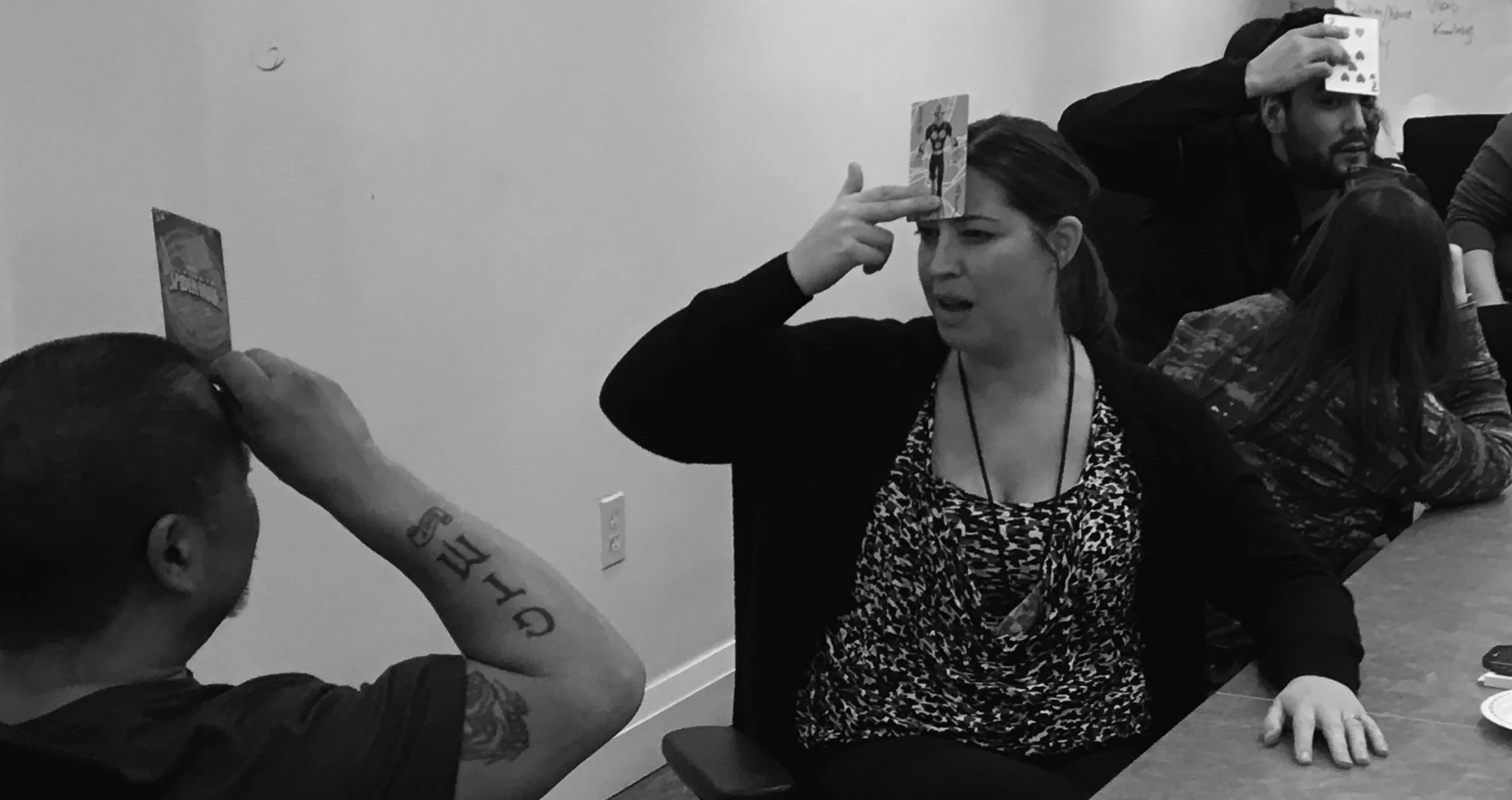
Exercise: “Status Cards”
Time: 10 minutes
Supplies: One deck of playing cards
Number of People: 2-50

Instructions

Ask everyone to find a partner. Introduce the exercise by saying:

This exercise is called “Status Cards.” I’m handing out a card to each person. Don’t look at it. What you’ll do is hold it up on your forehead facing out. Everybody you interact with in this exercise will see your card except you.

Now we’re going to do a role-play. Let’s pretend we’re all ourselves and we’re all mingling together after a recent all-hands meeting. Your job is to have casual conversation, but talk to people at the status level of their cards. That is, if they’re “high”, like queens, kings or aces, treat them as such. If they’re low, do the same. Talk over them, interrupt and otherwise show them that their status is very low. Don’t worry if you feel like you’re being rude - that’s part of what we’re exploring here!

As you get going, I want you to take the clues you’re receiving from others and start to take on the status you believe is represented by your card.

 Facilitation

  • Before starting the role-play, have a quick brainstorm session to generate a list of all the ways people perform status. Make a list on a whiteboard of “high status” and “low status” behaviors. Inform the group that this is a list they can draw from during the role-play.

  • Give the group their cards and then set them off into the role play. Set a timer for five minutes.

  • Encourage people to play up their status. High-status people should be dismissive, speak loudly, interrupt others and otherwise do all sorts of things that demonstrate their power. Same in reverse for the low-status people: speak softly, slouch, cower when being talked to. All the things that show they’re low status! Have fun and don’t be afraid to push people to heighten their interactions.

  • After 5-7 minutes, ask the group to line up from high to low status. Don’t let them look at their cards yet! They should be able to do this just by the way others were treating them.

  • Now have them look at their cards - how accurate were they informing their line? 

Debrief questions

  • How did it feel when others treated you based on your status?

  • What did you pay attention to? What were the strongest clues as to what your card was showing?

  • How did it feel to talk to high-status people? Low-status people? When were you most comfortable?

  • What did you do to show people their status?

Takeaways

  • Status isn’t something we “are,” it’s something we “do.” The way we interact with each other is what creates status. Sometimes the highest status people aren’t the VPs or Directors. Sometimes it’s the lower level people in an organization who people have the most confidence in and trust.

  • Being high status all the time isn’t necessarily everyone’s goal. Sometimes it’s helpful to lower your status relative to your team in order to increase trust and buy-in to a project. The smaller the gap between a leader and his or her team, the greater the perceived safety and trust between those managers and their employees.

After you try this out, let me know how it goes! I’d love to hear how you and your team understand the role of status in your unique organization.

End Boring Meetings With 8 Simple Ideas

siavash-ghanbari-jZi0Ih47EDY-unsplash.jpg

Take a moment and ask yourself: What was the best meeting you've attended this week? Who was there, what did you do and why was it so good? 

With so much of our time at work spent in conference rooms, it's important to think clearly and creatively about the way we spend our time together at work. Below I've put together eight simple ways you can use basic improv techniques to be more productive, engaged and entertained in your next meeting.

1. While everyone arrives, use a warm-up activity to set a collaborative tone

Meetings almost never start exactly on time, so instead of silently checking your email, why not use those first five minutes productively? In groups of 3-4, challenge teams to come up with as many ideas as possible for this year’s company holiday party. For the first two minutes, every sentence during the brainstorm must start with “yes, but”. For the next round, all sentences must start with “yes, and”. After both rounds are done, discuss as a group how changing “but” to “yes” altered the way you worked together. 

2. During the meeting, assign points of view

If your meeting involves brainstorming or providing feedback on ideas, try assigning “roles” to participants. Normal titles like “CFO”, “President”, “Finance Director” or more creative roles like “Elon Musk”, “The Queen of England”, or “An Excitable Eight-Year-Old” allow people to step outside their own experiences to think about how other people might perceive an idea. This technique encourages outside perspectives and new ideas that may not otherwise make it into the conversation.

3. Turn your challenge into a story

In eight sentences, you can tell the beginning/middle/end of any business objective by filling in the following blanks: “Once upon a time...Every day...But, one day...Because of that...Because of that...Because of that... Until, finally...And, ever since then…”. Try writing a few different versions out loud as a group and see if you can spark a new line of thinking on your KPIs and goals. 

4. Take turns asking “dumb” questions

We often say “there are no dumb questions” but still find that nobody asks any questions for fear of, well, looking dumb. Take a moment the next time someone explains a new or complex topic and propose that everyone in the room ask at least one “dumb” question. This helps mask any embarrassment and may provide important answers people might otherwise never receive.

5. Acknowledge that body language is part of a meeting’s dialogue

If someone is learning back in their chair, staring off into space, or checking their phone, these are clear indicators that they are not engaged. When this happens, pause and check in with disengaged attendees and ask what they’re trying to say with their body language. “I noticed that a few of us are not engaged in the discussion, is this topic valuable for you?” is a way to address this kind of issue. Conversely, if people are making eye contact, leaning in towards the speaker and nodding their heads, acknowledge these behaviors and confirm that what you’re seeing is in line with what you’re hearing. Connecting the dots between what people are saying with their bodies and with their words helps to ensure that all meeting participants understand and agree to the decisions made in the room.

6. Help virtual participants feel included by describing the room

The next time you and your team are stuck on a tough problem, try a “reverse brainstorm”. As a group, write down ten terrible ideas that would only make the problem worse. Often these terrible ideas are just a tweak or two away from a creative idea that would actually solve the problem.

8. Create an agenda and send it out ahead of time

I know this isn’t improv, but it seriously works! Every meeting needs an agenda, and if you’re struggling to come up with one, you probably don’t need to meet. Often the most productive meetings are the ones that never occur.

Joy, Humor and “Getting Over Yourself”: Values-Based Coaching in the NBA

Popovich (L) and Kerr (R) share a lighthearted moment before a 2014 regular season game.

Popovich (L) and Kerr (R) share a lighthearted moment before a 2014 regular season game.

Steve Kerr and Gregg Popovich are two of the most successful coaches in the NBA. Kerr won five NBA championships playing for the Bulls and Spurs and now coaches the Golden State Warriors. Popovich won five championships as coach of the Spurs, including two with Kerr as one of his most productive players.

Today, both coaches are widely respected as two of the best coaches in professional sports. Beyond winning together as a player-coach pair, these two men share a similar approach to coaching: Values-based leadership.

Kerr began coaching the Warriors in 2014. From the start, he built his team’s culture around four leadership values: joy, mindfulness, compassion and competition. To develop this list, Kerr combined his experience as an NBA player, executive and broadcaster with direct input from the Warriors players. The influence of joy on the team’s output is clear - Steph Curry dances after made three-pointers, Draymond Green emotes after every big defensive play and Kevin Durant, a new addition to the team this year, is frequently quoted saying how much fun he’s having playing for his new organization.

Over in San Antonio, Gregg Popovich is heralded as the coach who knows how to spot and develop “character” in the players he coaches. When pressed on how he’s able to identify a strong “character” in a young player, he bristles, saying that character is really a collection of specific, valuable traits that he and his staff can identify. For example, he lists Tim Duncan’s sense of humor as one of the reasons he was such a great player to coach: “Having a sense of humor is huge to me and to our staff because I think if people can’t be self-deprecating or laugh at themselves or enjoy a funny situation, they have a hard time giving themselves to the group.”

Humility is another one of Coach Pop’s key values. The Spurs have a phrase they use to evaluate new players, “Has he gotten over himself?”. The answer helps the coaching staff measure a player’s work ethic, humbleness and acceptance of his role. “Getting over himself” means that a player understands how his skills and limitations help or hinder the team’s ability to win. This concepts drives the way the Spurs attract veteran NBA players in free agency. Year after year their roster grows with superstar talents signing for less than maximum money to play a lesser role (fewer shots, fewer minutes, less media spotlight) for the chance to work alongside like-minded teammates devoted to winning an NBA championship.

Kerr won two NBA championships (1999, 2003) while playing in San Antonio under Popovich.

Kerr won two NBA championships (1999, 2003) while playing in San Antonio under Popovich.

Joy, a sense of humor, humility. These are the values espoused by highly successful NBA coaches. Gregg Popovich and Steve Kerr use these concepts to contextualize the demands they place on the highly-skilled people they lead. These values form the lens through which they evaluate and solve challenges in the complex and highly scrutinized world of professional basketball.

A values based leadership approach also works well for people working outside the world of sports. Here’s a thought exercise you can do to start developing your own list of professional values. The next time you have five free minutes, ask yourself the following:

  • What are the values you use to guide the way you work?

  • What are the common traits and characteristics of your favorite colleagues?

  • Which traits in your colleagues frustrate you?

  • When faced with a challenge, which of your own values help you organize the way you plan your response?

As a personal challenge, try to articulate your own list of 3-5 professional values. If you feel comfortable, do this with a colleague or friend and compare your lists. Do these values line up with the values of the organization you work for? If they don’t, what can you do to start a discussion to bring these values to the forefront of your work?


Fast Company: Improv for Interviewers

Screen Shot 2019-10-20 at 1.37.00 PM.png

Dave Collins, Founder and CEO of Oak and Reeds, was interviewed in Fast Company on ways to integrate improv into a company's interview process. Below is an excerpt:

Brainstorm the questions you need to ask to get the information you need about the candidate beforehand. Have those ready, but also be prepared to go off-script if the opportunity arises. Collins uses a "question-asking funnel," where the interview starts with very broad questions, then more specific, probing questions are used as various lines of discussion develop. The key is to keep the conversation fluid, listen intently, and to be ready to follow an interesting thread when it emerges, he says.

"What I like to teach in improv is called ‘color and advance,’" he says. Use an open-ended question to get the color that the person will share in the story, then use an "advance" question to drill down into the specific skills about which you need to know.

Read the full interview here.