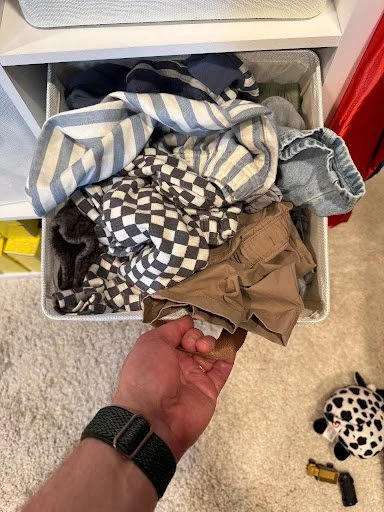
A terrifying sight
This morning I was defeated by tiny, size 5T pants
My three year old needed to get dressed. In his closet were brand new pants that my wife had just bought, that I had just washed and put away, that I knew for a fact would fit him. I stared at them. Then I put him in the same old sweatpants he's been wearing for months.
I told my wife about it at breakfast and she made fun of me, which was extremely well deserved.
“Aren’t you a change management expert? You couldn’t handle the new pants so you panicked and put on the old sweatpants?”
But I kept thinking about it on the drive to preschool. What exactly stopped me? It wasn't the pants. It was that the pants were new, and my morning routine is a tightly choreographed operation between bed and school drop-off, and my (extremely uncaffeinated) brain decided that introducing one unfamiliar variable into that sequence was a bad idea. I was in fight or flight mode and I chose flight.
That's change denial. At tiny pants scale.
What's actually happening at the beginning of change
I teach a workshop called Adapting to Change, and the core model in it is the Change Curve, adapted from Elisabeth Kubler-Ross's work on grief.
In this emotional model of change, there are six stages: Shock and Denial, Anger and Frustration, Confusion and Depression, Acceptance, Problem-Solving, and The New Normal.
Stage one (Shock and Denial) is the one nobody thinks applies to them. Here's what it actually sounds like in a workplace:
"My role isn't affected."
"That's someone else's problem."
Quietly hoping it just won't happen.
Carrying on with completely normal behavior and normal work.
That last one is the tell. Denial rarely looks dramatic. It looks like a person who skipped the optional training session and is still running the old process, perfectly calmly, six weeks after go-live.
I use my own example in every session. January 2020, I'm reading the news about a virus and thinking, that's not going to affect a guy whose entire business is getting on planes and standing in conference rooms with thirty strangers for three hours. I was teaching the Change Curve at the time. It did not help.
Denial is not a discipline problem and it's not stupidity. It's an evolutionary self-protection mechanism. Your brain is rationing how much new information it lets in at once to keep you safe.
The 48 Hour Rule
So here's what I do now, and it's embarrassingly simple.
When a small change shows up, a new process, a new tool, a tweak to a routine, I don't act on it and I don't decide about it. I let myself notice the resistance. Then I put it down for two days.
When I come back to it 48 hours later, it isn't new anymore. It's been processing in the background of my brain the entire time. The decision that felt like a whole big thing on Monday is just a task on Wednesday. Nothing about the change moved. My relationship to it did.
The rule works because stage one is mostly about novelty, not substance. Give the novelty two days to wear off and you're usually starting from stage four instead of stage one.
Three places this tends to land:
A technology you haven't tried yet. The new system went live, you've been running the old workflow, and you've been telling yourself you'll get to it. Open it for five minutes today. Decide nothing. Come back Thursday.
A team change you keep reframing as someone else's. New reporting structure, new territory, new leadership. Ask yourself honestly: is my role really unaffected, or is that the most comfortable available read?
A small ask from your manager that you've quietly not done. Note the resistance instead of arguing with it. Two days later, ask whether it's still there.
And if you manage people, the more useful version of this is spotting it in someone else. In the workshop we run an exercise called Change Curve Mapping where people answer four questions about a real change they're in the middle of:
Where are you on this curve?
Where are the people going through it with you? Name two.
Pick one of them. Why did you place them there? What are you actually hearing and seeing?
What could you do to coach that person to the next stage?
The answers are almost always more specific than people expect. Someone always realizes they've been treating a stage one person like a stage five person and wondering why nothing lands.
Practice this exercise on your own (with AI as your coach)
I built a free set of prompts that walks you through the Change Curve and the 48 Hour Rule on a change you're actually facing right now. You paste them into whatever AI assistant you use and it coaches you through placing yourself on the curve, pressure-testing whether what you're feeling is denial or a real objection, and rehearsing a conversation with someone stuck in stage one.